Readit News logoReadit News
quikee commented on LibreOffice blasts OnlyOffice for working with Microsoft to lock users in   neowin.net/news/libreoffi... · Posted by u/XzetaU8
fweimer · 22 days ago
How does LibreOffice handle ODF standardization? If they want to add a new feature that result in changes how things are formatted visually, write they papers to update the ISO standard for ODF, working with other office suite implementers to achieve interoperability, wait a couple of years for the new standard with the changes getting published, and finally turn on the feature for users?

My impression is that this is more or less how ISO standards are supposed to work. Personally, I don't want to work in such an environment.

quikee · 15 days ago
Well, that's almost how it work but of course without the waiting bits. The change would be added to LOExt namespace and would be written to the document and read on load. Then the change is proposed for inclusion into the next ODF version. Once the ODF version is released, LO would add support for that as well and changed if needed. On next save the feature would use the ODF version instead of LOExt.

The process has its issues and could cause problems, but in practice I don't remember anyone reporting issues.

quikee commented on WebP is so great except it's not (2021)   eng.aurelienpierre.com/20... · Posted by u/enz
mceachen · 2 years ago
Careful with the JPEG-XL re-compression, though--depending on how you're re-encoding, jxl may use SSIM to evaluate for visual losslessness, and the whole point of TFA is that SSIM is blind to posterization, but (some) humans aren't.

Disk space is cheap. It's most likely not worth the 20% compression to lose your original images (and possibly lose metadata as well--it's quite hard to robustly retain all vendor-specific MakerNotes, for example).

quikee · 2 years ago
JXL has Guetzli lossless JPEG compressor integrated into the standard so it produces reversible and completely standard compliant JXL images that are 15-20% smaller size. Reversible in sense that you can still convert the image back the original JPEG, that is bit exact file as the input JPEG was (it takes care of all the metadata also - it has to).

Also if you decide to forgo the reversibility you can get a bit more out of it as JXL is actually a superset of JPEG, so it can read the JPEG stream and convert it to JXL without complete recompression - it will just use more efficient structure of JXL and much more efficient (ANS vs. Huffman) entropy encoding. The additional savings compared to the reversible mode aren't big however.
quikee commented on WebP is so great except it's not (2021)   eng.aurelienpierre.com/20... · Posted by u/enz
Semaphor · 2 years ago
> I wonder if there's some issue with the WebP encoder (or the settings) he is using?

I played around with online optimizers and IrfanView which I had locally. IrfanView got the results they did, no matter what else I tuned, obvious degradation at 90. Online optimizers were not even comparable in how bad they were.

edit: I found Squoosh [0], which has WebP V2 compression marked as unstable. It’s far better, half the size of JPEG 90, but it’s still degraded in comparison. Also, it saves as wp2 file, which neither Chrome nor FF support natively.

[0]: https://squoosh.app/editor

quikee · 2 years ago
They ceased development on WebP2.. don't think they could've come up with anything better than AVIF or JXL already have anyway.
quikee commented on JPEG XL against AVIF tested on ImageEngine   mastodon.online/@jonarnes... · Posted by u/ksec
CharlesW · 3 years ago
USAC doesn't meet the "ubiquitous" requirement for this use case.

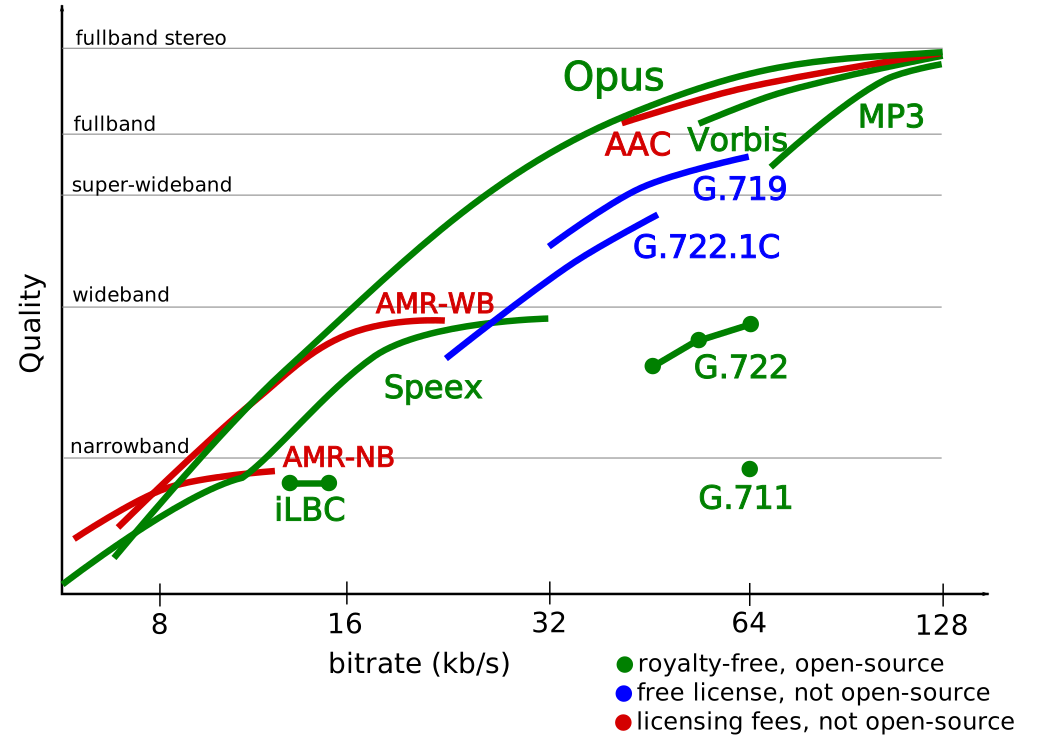
Regarding your claim that Opus is better than HE-AAC, here's a "Quality vs Bitrate" chart from opus-codec.org, the home of Opus: https://opus-codec.org/static/comparison/quality.svg

Note that AAC (presumably they mean "Main Profile" rather than AAC-LC) has effectively the same efficiency as Opus. HE-AAC and HE-AACv2 have a higher efficiency than both Opus and AAC, and works great at lower bitrates in comparison to AAC.

quikee · 3 years ago
"Regarding your claim that Opus is better than HE-AAC, here's a "Quality vs Bitrate" chart from opus-codec.org, the home of Opus: https://opus-codec.org/static/comparison/quality.svg

Note that AAC (presumably they mean "Main Profile" rather than AAC-LC) has effectively the same efficiency as Opus. HE-AAC and HE-AACv2 have a higher efficiency than both Opus and AAC, and works great at lower bitrates in comparison to AAC."

This chart just roughly outlines (according to the feeling of Opus developers at that time) what to expect from Opus - a wide range of useful bitrates. It's not anything that was actually measured or something that can be used for drawing any conclusions from it. I mean - those nice curves and lack of any detail about the codecs used should give it away.

According to public (double blind) listening test that were performed by the Hydrogen audio group Opus does win over best HE-AAC codecs available at time when the test was performed - both at 64kbps and 96kbps bitrates [1] (Multiformat Tests).

[1] https://wiki.hydrogenaud.io/index.php?title=Hydrogenaudio_Li...

quikee commented on JPEG XL against AVIF tested on ImageEngine   mastodon.online/@jonarnes... · Posted by u/ksec
CharlesW · 3 years ago
HE-AAC is a bit better than Opus, plus has the benefit of MP3's "works everywhere" experience. I posted more detail elsewhere in the thread if you're interested.
quikee · 3 years ago
xHE-AAC from 2016 (also known as USAC) yes. The older HE-AAC from 2003 and HE-AACv2 are not. Codecs have similar names, but they are different and released at different times.
quikee commented on JPEG XL support has officially been removed from Chromium   chromium-review.googlesou... · Posted by u/frankjr
kasabali · 3 years ago
Can't really blame camera manufacturers when RED is suing everyone who's shipped a feature even remotely resembling their patent portfolio.
quikee · 3 years ago
Well RED is mostly suing for their RAW video compression patents, which are just dumb an should never be allowed to be passed in the first place (and AFAIK Nikon is currently battling to invalidate that). But this is also their own problem - they haven't put almost no R&D into the software side of digital photography and videography like formats, processing. They have a nice camera which outputs 12-bit and higher images - they should be the first ones requesting and defining a new image format for consumption, which can handle that.
quikee commented on JPEG XL support has officially been removed from Chromium   chromium-review.googlesou... · Posted by u/frankjr
jl6 · 3 years ago
JPEG XL needs some support from the camera manufacturers. They’ve mostly gone with HEIF so far and seem unmotivated to do anything different.
quikee · 3 years ago
Camera manufacturers are old spineless companies. In all those years they have done nothing for digital image formats and it is the most important thing in a camera. They weren't even able to come up or attempt to make a standard RAW format. All that came from Adobe (DNG), which the camera manufacturers happily ignored for their own proprietary solution until this day.
quikee commented on JPEG XL support has officially been removed from Chromium   chromium-review.googlesou... · Posted by u/frankjr
masklinn · 3 years ago
> I wonder what exactly they mean by this because JPEG-XL is a ISO standard.

So were JPEG-XR and MJPEG2000.

quikee · 3 years ago
and neither of your examples is experimental
quikee commented on JPEG XL support has officially been removed from Chromium   chromium-review.googlesou... · Posted by u/frankjr
brigade · 3 years ago
That's as useful as saying DNG can be powered by lossless JPEG. No standard lossless JPEG decoder can do anything useful with DNG files.
quikee · 3 years ago
Most RAW formats are based on TIFF... no standard TIFF decoder can decode a RAW format either.
quikee commented on JPEG XL support has officially been removed from Chromium   chromium-review.googlesou... · Posted by u/frankjr
brigade · 3 years ago
Also cameras. Which either aren’t interested (no one really cares about non-RAW formats on DSLRs), or are going AVIF once hardware encoders land (Android phones)
quikee · 3 years ago
DSLR market has pretty much stopped (rarely any new DSLR camera is released) as everyone shifted to mirrorless cameras. Camera manufacturers mostly added HEIF (Canon, Sony, Fuji) as the non-RAW image format, because they already have HEVC for video.

Camera with a lossy / lossless 12-bit, 14-bit JPEG XL would definitely be interesting for many photographers. Not everyone wants to be forced to do a complete post-processing with RAW. JPEG is to limited (8-bit only) and HEIF isn't much better, while not having much support (especially on the web) because of the patent situation.

u/quikee

KarmaCake day2June 21, 2017View Original