What’s with this recent push for ID verification from every site and service?
Cowering to autocrats all over the world.
 Readit News
However, when you DO need to do something special (like create a new endpoint), the LLM knows where to get more info on this.
Kinda like a library of „how to“ books.
Instead of drawing the anger of the US, just .. slowly over time, sell all the gold off, and move the money back. And use it to build infrastructure or something. Much better than gold.
There’s a famous billionaire founder in Germany that attempted suicide just recently, because … he didn’t feel useful anymore.
https://7news.com.au/news/ex-boss-of-major-textile-brand-tri...
1) the 50% net wealth tax vis-a-vis 1948 currency reform?
2) which 2 richest families in Germany hold more wealth than the bottom 50% combined?
3) most wealth distribution plots I have seen show a significant negative start (people in debt) then a large number of people with effectively 0 net wealth (what is earned is spent) and then a rise towards the haves. From such plots for different nations I am not surprised that the lower 2 digit percentages effectively have net 0 (with those in debt balancing those having a mediocre surplus), so it would seem trivial for this factoid to be true in many nations (with a slight change of the 50% number or a slight change of the exact number of richest families)
The perspective you give is certainly remarkable in the sense that the Nazi rise was basically a counterreaction to the rising popularity of communist ideas, with the end result... a redistribution of wealth after all, not even a holocaust could stop the wealth redistribution.
2) https://www.die-linke.de/fileadmin/user_upload/20230530-PK-A...
3) theoretically people could own via the state: if the state has resources (eg. hospital buildings, schools) that benefits all people ~uniformly. However, due to privatization more and more government wealth is also sold off.
Wealth redistribution is the only way the living standards of ordinary families will improve. I’m just hoping we can skip the war part, this time. I think its possible.
Quite frankly, considering the wide diplomatic damage and collapsing influence, paired with its deep social, cultural and economic internal issues... I can totally see the US failing. They depend so much on power projection and economic influence, I don't see how they could possibly manage on their own. What will happen to the dollar if the US isn't guaranteeing stability anymore? The debt will explode and former allies may call on their stake. Due to the AI bubble, the American economy is worse than it looks. It may all come down together.
Is California going to hold the bag for Florida? What's being American other than an international embarrassment and a bully, at this point? How strong is the shared identity when it comes to it? With ICE and all, can they get over the differences in "opinion" about who's deserving human rights and who doesn't?
A similar instance of this is happening currently in the talks between EU/UK — The EU is demanding a „Farage“ clause. They want a guarantee that the damages are paid for in case Farage becomes prime minister and will roll back all treaties and trade deals and what not.
Which, to be fair, makes total sense.
[1] https://www.worldometers.info/world-population/germany-popul...
This means that the working class had immense wealth and so simple jobs could support a family on a single income, buy a house, etc.
Compare that to today — the two richest families in Germany hold more wealth than the bottom 50% COMBINED.
It is no wonder that normal families cannot afford to buy property anymore; and are forced to rent. This further exacerbates the wealth gap.
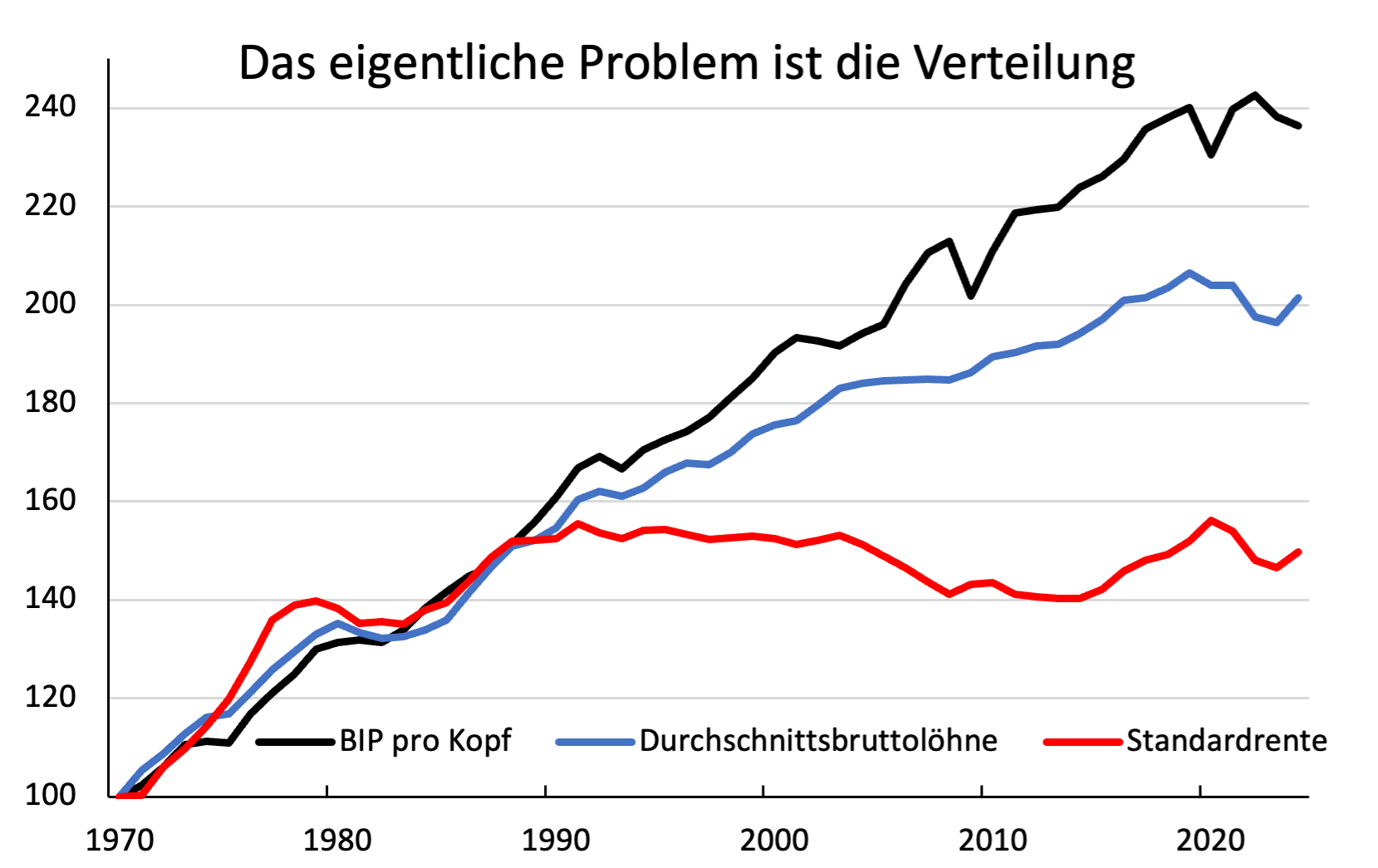
Another nice statistic is the productivity VS wage VS pensions curve: https://substackcdn.com/image/fetch/$s_!KDug!,f_auto,q_auto:...
(Black line - GDP, blue line - avg comp; red line - avg pension)
In short - the productivity increased; but ordinary people are being squeezed out of the gains regardless. No wonder that everyone turns sour at some point.
If people had their rents cut in half, it would solve most other money problems they complain about (shy of those who will just inflate their lives into being money constrained again).
Of course this will come mostly at the expense of regular middle-class homeowners, who will see the enormous paper gains of their properties in the last 5-10 years be decimated. Red or Blue, I don't care who, hates losing money and will emphatically vote against this happening.
It’s easy to see why: there already IS enough housing around for everybody. If there wasn’t, you would see a massive amount of homeless people. And even in the US where that might be the case - the amount of empty real estate is larger than the amount of homeless people. You could easily house them if you wanted. It’s a question of distribution.
The other reason to see why this doesn’t work is: there is no country that managed to do it. Miraculously, the housing crisis has hit all (western) countries on the planet. All of them try to build their way out of it, no one succeeds. Why?
If you just mass build, the new units will be bought immediately by the rich, and the working people will have no housing still.
In each case, people came up with relatively "popular" solutions (one of them is still in progress)
In each case, the elected officials all but ignored the output, on the ground that the body had not been elected, was manipulated by experts, had no responsibility and accountability, etc...
Anyone who solves this will indeed have found an improvement over elective democracy.
In the case of the US, a lower hanging fruit would be getting out of "elections that can easily be bought by corporations with litteral money".
In fact, it does work, and it is already implemented! Here in Germany we also have the concept of „Bürgerräte“, and we have similar problems as in France (no political power to implement their solutions).
However, one takeaway was that people vastly underestimated how carefully the participants would try to understand the topic at hand. People that would usually just regurgitate angry propaganda were forced to form their own opinion and they did!
IMHO it’s this is a great tool for democracy that is yet underused.