Readit News logoReadit News
yitosda commented on Egyptian ‘bent’ pyramid dating back 4,600 years opens to public   independent.co.uk/news/wo... · Posted by u/everbody
yitosda · 7 years ago
Fascinating data. There's a breakdown per-state showing that only eleven states have a lower homicide rate than Egypt.

Looks like Puerto Rico, District of Columbia and Louisiana are the worst as of 2012 (latest the set shows unfortunately). Puerto Rico is an outlier at 2x the next, but District of Columbia has improved massively between 2000 and 2012.

EDIT: This might be a bit misleading. While there is more recent data for the US (up to 2016), there seems to be no reliable data on Egypt post 2012. Additionally, the 2012 number (2.5) represents a 4x /increase/ in homicides since 2003 (0.6). Only 2011 (year of the Egyption revolution) was higher at 3.2. So there's a clear trend towards an increase in homicide rates that might not be accounted for.

That said, I guess it's unlikely that the number is much higher than the US average, even discarding the outliers mentioned above.

yitosda commented on Despite High Hopes, Self-Driving Cars Are ‘Way in the Future’   nytimes.com/2019/07/17/bu... · Posted by u/seibelj
ChuckNorris89 · 7 years ago
Self-driving tech muggle here.

Could someone explain to me why any average Joe with minimal intellect can drive a car using only a pair of eyes but it's difficult to build a fully self-driving car even with 8+ cameras, GPS, LIDAR and other sensors us humans don't have?

yitosda · 7 years ago
In a word, context.

Human brains are just context gathering pattern matching machines. We can't even count without all kinds of context being automatically bubbled up into our consciousness.

When we see other drivers, we can take all kinds of subtle hints about their behavior. We can easily tell if they have an unsecured load (not just if it's currently shaking). We can see the way someone is looking at the road to know if they are going to go, if they're hesitating, if they're high. We can know where the road is even though it's snowed out because of the approximate distance from the ditch you remember being 15 feet out alongside it.

There are zillions of cases like this in the long tail. Self driving cars leapt forward by being able to answer the vastly important contextual question of "what is this in my sensor?" -- but to do the rest, it's hard to overstate how much a computer would have to "be human". To be able to apply past experience, psychology and complicated inferences about "why is this in my sensor? what can I do about it?"

In the end, self driving cars will thrive, just in an environment that poses these kinds of questions as little as possible.

Or we'll actually get a breakthrough and be able to create NNs that allow machines to learn and apply a vast breadth of learned context to sensory input. Teach them vast amounts of unrelated things just as every human learns in the 16 years before they drive (and then some), and then effectively put extra-sensory humans on the road.
yitosda commented on The PGP Problem   latacora.micro.blog/2019/... · Posted by u/wrench4916
fipar · 7 years ago
So, as a technical person (I can write and debug software, deploy it to production, etc.) but only an end-user when it comes to cryptography:

What are the biggest weakenesses of using PGP for local file encryption?

My use case is I have a 'vault' of secrets that I store in a gpg-encrypted org file, with a key binding in emacs to let me easily decrypt this 'vault'.

The encryption is done with gnupg's symmetric encryption, i.e., just me typing a passphrase, not using my private key. This encrypted file resides in a Filevault-encrypted drive, and is backed up to a an encrypted TimeMachine backup. It never leaves my local drive or the external USB drive I use for backups (at least not that I know of).

What are my biggest risks here? I did not get much info from the article on this use case other than "perhaps wait for age". I understand I could be using an encrypted volume that I mount on demand, which I already do for other use cases, but that would get rid of the convenience of having this "vault" available to me just one emacs shortcut away. I'm willing to give that up if the risks are big enough but I'm kindly asking the knowledgeable HN audience for advice to see what I'm doing is really that bad.

yitosda · 7 years ago
There's nothing wrong with this. Public/Private keys are for sharing secrets and proving identity.

Assuming you are using a sane cipher and mode, your risks boil down to any of a myriad of methods of stealing/bruteforcing your key or grabbing the unencrypted file.

yitosda commented on Man as a Rationalist Animal (2017)   samzdat.com/2017/05/22/ma... · Posted by u/simonsarris
manifestsilence · 7 years ago
The problem isn't even one of over-simplification; it's that logic does not inherently possess values. Logic can only tell you whether a conclusion follows from premises, not whether those premises are correct. It can tell you whether an idea is consistent but not whether it is good.
yitosda · 7 years ago
This is exactly what I'm talking about. You've narrowed down the scope of logic to apply to everything !good, which is some emotional value that exists outside of logic. In reality "good" is a vast trove of information which differs in the minds of every party to the problem.

Logic absolutely applies to this set of information!

Wanna-be technocrats should understand that exploring that vast trove of information (which they can't actually do, in practice) will allow a more widely accepted solution.

Accounting for all these various "goods" logically results in messy compromises which run exactly counter to the technocratic dream.

Democracy is an imperfect attempt to distribute the logical calculation of all these "goods" and come up with a big ugly messy solution.

(Some parallels with capitalism exist here)

yitosda commented on Man as a Rationalist Animal (2017)   samzdat.com/2017/05/22/ma... · Posted by u/simonsarris
SolaceQuantum · 7 years ago
Yes, I agree- but what fo you mean by "merely scoping the problem in a novel way" and how does it differ from the way I describe scoping?

(Not attacking, genuinely curious because I'd love to find new and more useful courses of action when it comes to problems...)

yitosda · 7 years ago
I think we are both arguing that some people narrow the scope of arguments to the point that they aren't useful to the original problem, merely more amenable to logic. Let's call this "not useful scoping".

I further argue that useful scoping (isolating the problem in a way that solving it provides a solution amenable to all those who proposed the problem) often /is/ the hard work, itself a product of much time and logic.

Far from proposing a useful course of action: I simply lament that we will often choose our scope to support simple logic, rather than use complex logic to improve the scope.

No surprise either: each life only has so many hours.

yitosda commented on Man as a Rationalist Animal (2017)   samzdat.com/2017/05/22/ma... · Posted by u/simonsarris
SolaceQuantum · 7 years ago
"Tech/nerd/stem types absolutely love to do this. We take a problem, pare it down to its essence and then solve it."

In my experience, the tech/nerd/stem types being hypothesized about actually do not pare a problem down to its essence. They instead do the equivalent to attempting to solve the screaming of a hungry child by assuming the essence of the problem is that "too much sound", so we put the child in a soundproofed room.

In truth, it is entirely possible to apply pure logic to a problem if the problem is appropriately scoped to closely align with actual reality. In my experience, to deny the emotional aspects of something is actually irrational behavior- it makes incorrect assumptions that the only things that exist are what the tech/nerd/stem person understands themselves.

This results in the hypocritical behavior of a tech/nerd/stem type crying out (emotionally) to solve the problems of emotionality.

yitosda · 7 years ago
I think we agree, but I appreciate that my wording wasn't perfectly clear.

"pare down to its essence" was a bad way of saying "disregard intersecting issues and focus on one logically resolvable issue." Your soundproofed room analogy is apt.

I also agree with applying pure logic to a scoped problem being not only possible but desirable... but I'd argue that properly scoped problems are rarely as useful to solve as the scoper might think. In many cases "merely" scoping the problem in a novel way leads directly to a truly useful course of action, and is most of the hard work.

I agree completely with emotions being something we should not deny, but rather be something to /include/ when trying to solve problems. (My complaints are around emotions being placed outside or opposed to the realm of logic, where accounting for them is "illogical")

yitosda commented on Man as a Rationalist Animal (2017)   samzdat.com/2017/05/22/ma... · Posted by u/simonsarris
jankotek · 7 years ago
This "spock" character is just another form of rationalism. It has a long history, for example french revolution.
yitosda · 7 years ago
That's true, but it doesn't really have much to do with my points:

* Common (current) culture around rationalism fantasizes about the human using it being able to choose the best course of action in every situation (and examples to the contrary are typically full of woo-woo about human emotions and souls). This is computationally impossible for the brain.

* Hacker-news-audience-types will often discard important nuance on a topic in order to reduce it to something that can easily be rationalized about.

If historical cultures may have "suffered" from the same delusions, it would be more interesting to see how my points did or didn't apply than saying that they existed.

yitosda commented on Man as a Rationalist Animal (2017)   samzdat.com/2017/05/22/ma... · Posted by u/simonsarris
yitosda · 7 years ago
There's a ton of (especially early) nerd culture idolizing many forms of what most people know as the "Spock" character (somewhat more accurately, Vulcans in general). This is typically contrasted with emotions, sometimes as a mystical part of the human soul that exists outside of logic, sometimes as the source of evil.

It's a constant bother. The only way to apply pure logic to any problem is to pare it down to a mockery of the real world problem. That's why we have "gut" or "emotions": We apply imperfect patterns to complex issues, otherwise we'd never make it through a single day; it's an optimization.

Tech/nerd/stem types absolutely love to do this. We take a problem, pare it down to its essence and then solve it. When no one listens and no logical counterargument prevails, the cries for technocracy start to ring out. A classic attempt to dissect this fallacy was the old blog post "What color are your bits?" [1]

As technology companies continue to grow in power relative to all other companies and governments, I'm very interested in watching how this plays out.

[1] https://ansuz.sooke.bc.ca/entry/23

yitosda commented on Open-Source Slack Alternative Mattermost Gets $50M Funding   itsfoss.com/mattermost-fu... · Posted by u/wheresvic1
abraka · 7 years ago
you mean like... the official dekstop client @ https://github.com/mattermost/desktop ?
yitosda · 7 years ago
It's odd that that page refers to the desktop client as "native". The parts of an electron app that are native to the OS (as opposed to the OS-independent HTML/JS) are irrelevant to most people's desire for "native" apps.

Electron is not native.

yitosda commented on U.S. Life Expectancy Drops for Third Year in a Row (2018)   smithsonianmag.com/smart-... · Posted by u/EL_Loco
tapland · 7 years ago
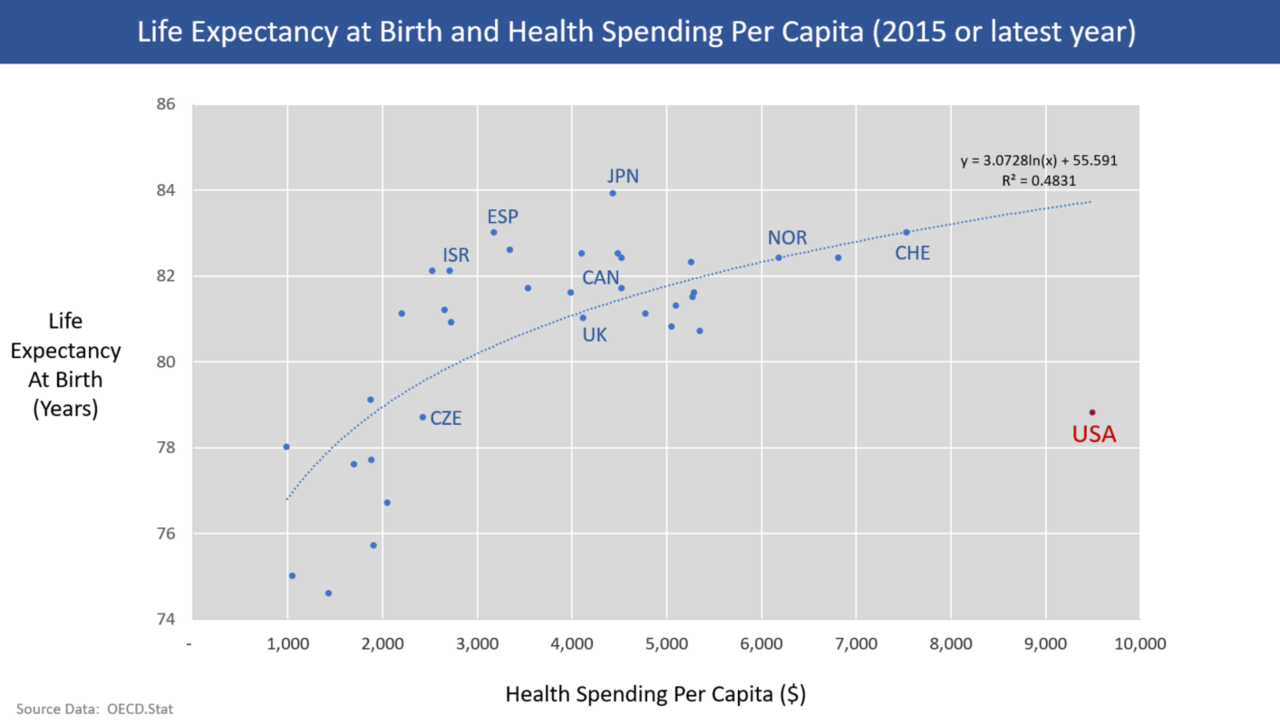
> My uninformed impression is that in the US one does not pay proportionately the same amount of taxes towards healthcare (maybe you have citations to the contrary?).

Each and every report of US healthcare costs and funding. I'll just grab from the wikipedia article [0] for now.

> Public spending accounts for between 45% and 56.1% of U.S. health care spending.

And one of the pretty handy graphs [1]

Worth noting that this is with a lot of people unable to afford treatment.

[0] https://en.wikipedia.org/wiki/Health_care_finance_in_the_Uni...

[1] https://upload.wikimedia.org/wikipedia/commons/thumb/f/f7/OE...

Edit: Has to be coupled with public spending in other nations to be complete. There is another article related to the graph [2] with another easy to understand graph [3]

[2] https://en.wikipedia.org/wiki/List_of_countries_by_total_hea...

[3] https://upload.wikimedia.org/wikipedia/commons/thumb/0/0b/OE...

yitosda · 7 years ago
Your citations seem roughly in line with what I said and expected: Americans pay double overall, with a similar dollar amount of public healthcare.

Proportionately speaking, that means Americans are not taxed the same (higher incomes). Interestingly, based on what I'm seeing re: incomes, the /total/ healthcare expenditure is, as a proportion of income, the same between the US and western Europe.

Overall this seems quite unsurprising: healthcare is expensive, the US pays more and the government spreads it around less. Worth noting that health and lifestyle in the US is also "worse" (more cultural than healthcare related).

u/yitosda

KarmaCake day133January 19, 2017View Original