Isn't the issue of products like this that they present PHC risk, jeopardize QSBS - particularly at the earliest stages where revenue is de minimis?
 Readit News
tjpd commented on Launch HN: Palus Finance (YC W26): Better yields on idle cash for startups, SMBs · Posted by u/sam_palus
tjpd commented on The German language broke my website speedbumpapp.com/en/blog/... · Posted by u/nullderef
Surely this is the perfect opportunity to take advantage of German’s agglutinative nature and come up with your own?
Handyschwelle?
Or more formally: Mobiltelefonbremsschwelle?
tjpd commented on China is flooding Taiwan with disinformation economist.com/asia/2023/0... · Posted by u/2OEH8eoCRo0
Glass hearted is a Chinese insult meaning you are weak minded and/or easily offended.
Pinkie is a term used to describe young pro-China online posters.
tjpd commented on Using a "proper" camera as a webcam tratt.net/laurie/blog/202... · Posted by u/ltratt
I hate to say this but it’s almost entirely not worth it.
The image quality only shows up here because they’re uploading images that they took from the camera locally. Trying doing it with Zoom.
The compression is absolutely terrible. You’re gonna find that you spent a lot of time and money only to see a decent quality image on your side. Everyone else is gonna see the same muddy mess that they always saw.
The image is always bad due to the compression. If you’re a twitch steamer or something where you’re doing a 50mbps bitrate then whatever. But for most folks - there is little to no improvement. Your best way to improve image quality would be to improve lighting. Even a good camera will have a bad image with bad lighting.
Respectfully, I have to disagree. I have a similar setup to the one in the article (Sony A6400 + Simga 30mm f1.4) and the difference in image quality is dramatic _even over Zoom_. It is such an improvement that, in my experience, almost every first meeting that I have with someone over Zoom the other participant will remark on how good my picture is. The perception of "quality" has little to do with resolution issues or compression artifacts and far more to do with good framing/focal length, focus depth and bokeh all of which a good camera setup has in spades and all of which webcams lack.
I don't really understand what problem they're trying to solve. Contacts don't really wear out if they are tightened correctly and there was definitely no need for this on the 3-phase side of the driveline.
But you add induction coils like this and you're nearly going to need a medium as big as the motor itself to transfer that energy over an air gap.
It's also dumb to say 'no wear, we removed the last interface!!'. The motor is full of bearings. It actually seems to have twice as many bearings as a normal motor. So yes, you will need to replace all those bearings and it will be a right pain compared to just tightening a bolt for each of the phases.
The article states another benefit of the motor is that it doesn’t require rare earth elements, so presumably they’re trying to solve the ecological and supply problems presented by rare earth mining.
https://en.m.wikipedia.org/wiki/Rare_earth_industry_in_China
tjpd commented on Is San Francisco about to return to its Bohemian roots? sfgate.com/sf-culture/art... · Posted by u/arunbahl
As an SF resident for at least as long as the author I can sympathize with a lot of the sentiment but I'm skeptical about the some kind of renaissance when the city's budget is deteriorating badly.
Rather, when you add it all up: the loss of many of the things that made SF fun; increasingly distributed labour, capital & opportunities for start-ups/VC; SF's seemingly unsolvable problems (cost of living, homelessness, spotty public education, irregular transit, weather...) - just what is the bull case for SF anymore?
I honestly wish I had a good answer.
> very generous floor of the wealth tax
> and it seems to me applicable to a very narrow case
The floor of the wealth tax doesn't really refute the central argument, because it just means that it impacts anyone who owns a business worth over $50 million. This is a LOT of businesses in the US!
> and even in that case doesn't have drastic consequences.
That level of liquidation and lost ownership will have potentially disastrous ripple effects on the economy, because for a lot of companies, the theoretical market value — upon which one's theoretical net worth ("wealth") is calculated — is based in large part on that individual maintaining ownership and control of the company. Once a founder starts liquidating large portions of their wealth and divesting their ownership, it's difficult to predict what that could do to the value of the company, and consequently the value of pension funds and portfolios that rely on the stability of the corporate value, and ultimately impacts the employees of those very corporations.
> The floor of the wealth tax doesn't really refute the central argument, because it just means that it impacts anyone who owns a business worth over $50 million. This is a LOT of businesses in the US!
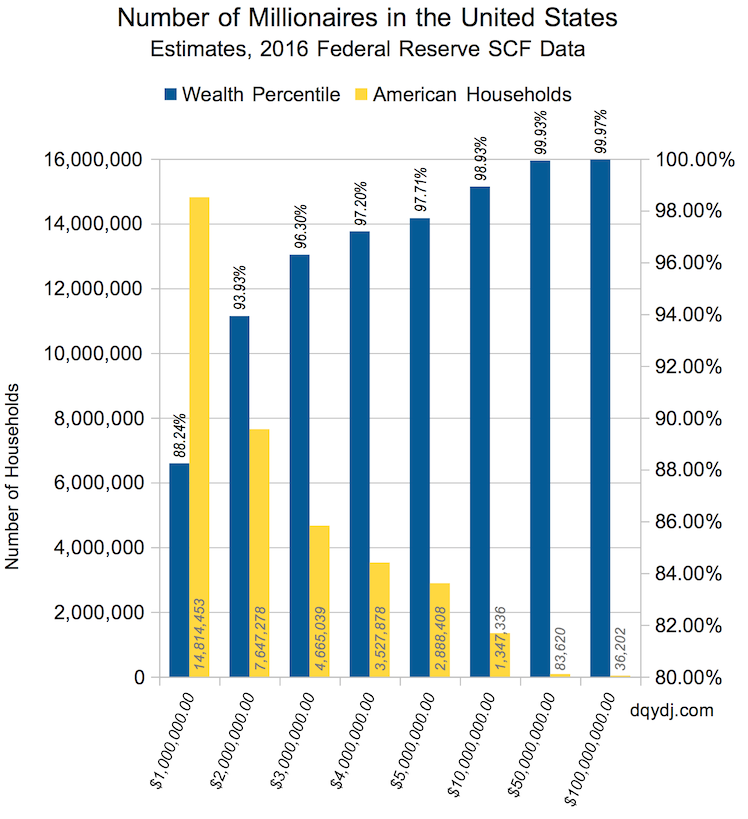
We can actually look at the Fed's Survey of Consumer Finances and get a reasonable number here. Household's with >$50m are top 0.07% percentile and there are approximately 84k of them out of around 130 million households....
[1] https://cdn.dqydj.com/wp-content/uploads/2017/09/millionaire...
I'm not a fan of this proposal but I think this line of argument is pretty flimsy and pretty specious.
In the Bay Area you're already subject to a form of wealth tax called property tax. And it's substantial. If you live in San Francisco you'll get charged 1.1801% every year [1] on the value of your wealth (property). If I bought a house in SF and live for another 60 years I would be taxed 60 times on that same asset. Does that mean the government will over the course of my life take 33.6% of my house?
It's not as if property tax has kept a damper on Bay Area house price inflation.
[1] https://sftreasurer.org/property/understanding-property-tax
Your company gets classified as a PHC (and is subject to additional tax) if investment income, including interest, is more than 60% of its revenue. This isn't something most startups need to worry about if you have any revenue.
QSBS is based on intent, if the IRS thinks more than 80% of your assets are used for investment purposes and not for actively running your business. Basically it's so people don't use a small business tax exemption as a loophole for their investments. But the IRS absolutely considers idle cash in your company treasury as part of running your business, or else any startup that's raised money and didn't immediately spend it all would be considered an "investment vehicle," which they obviously don't.
Moreover, any of these potential issues would apply equally to a startup doing anything with their treasury, including putting it in a money market fund as most startups do. So we're not introducing any new tax risk. But of course, if any startup thinks these might be an issue for their business, they should talk to their tax advisor.