Sounds like either history is repeating itself or she was about 30 years early with her prediction.
https://substackcdn.com/image/fetch/$s_!diR3!,f_auto,q_auto:...

Sounds like either history is repeating itself or she was about 30 years early with her prediction.
https://substackcdn.com/image/fetch/$s_!diR3!,f_auto,q_auto:...
These AI researchers will probably have far more impact on society (good or bad I dont know) than the athletes, and the people who pay them (ie zuck et al) certainly thinks its worth paying them this much because they provide value.
Are there 250 million AI specialists and the ones hired by Meta still come out on top?
That's, like, the least nuanced and most caveman-brained take on climate change you could possibly develop.
Also: appealing to edge-cases as a distraction isn't nuance, it's derailing. I can find fucking exceptions to anything. ANYTHING. How many people in the West are growing their own chickens? Give me a fucking break man.
I did not point out exceptions and the chicken example is merely an illustration of one of my points.
And who says we are talking about the west? Plenty of comments in this thread are talking about pandemics, something that is not known to originate from western agriculture.
You know what‘s a caveman take? Thinking that there is any chance to convince a meaningful number of people to reduce meat consumption globally in the required time window (20-50 years) in a way that has any bearing on climate change (as opposed to the many steps being taken that actually work). That‘s a caveman take.
But now some facts:
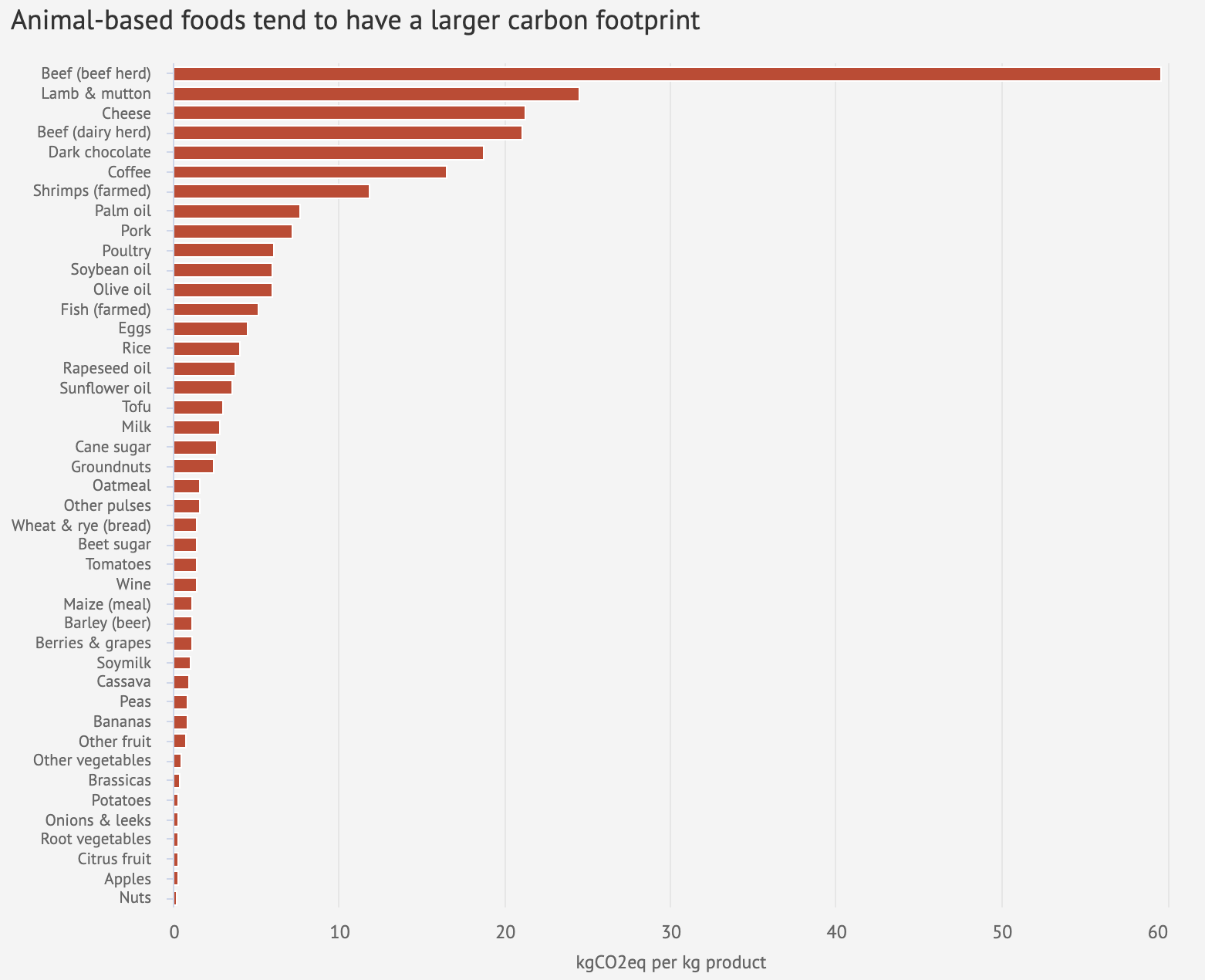
https://interactive.carbonbrief.org/what-is-the-climate-impa...
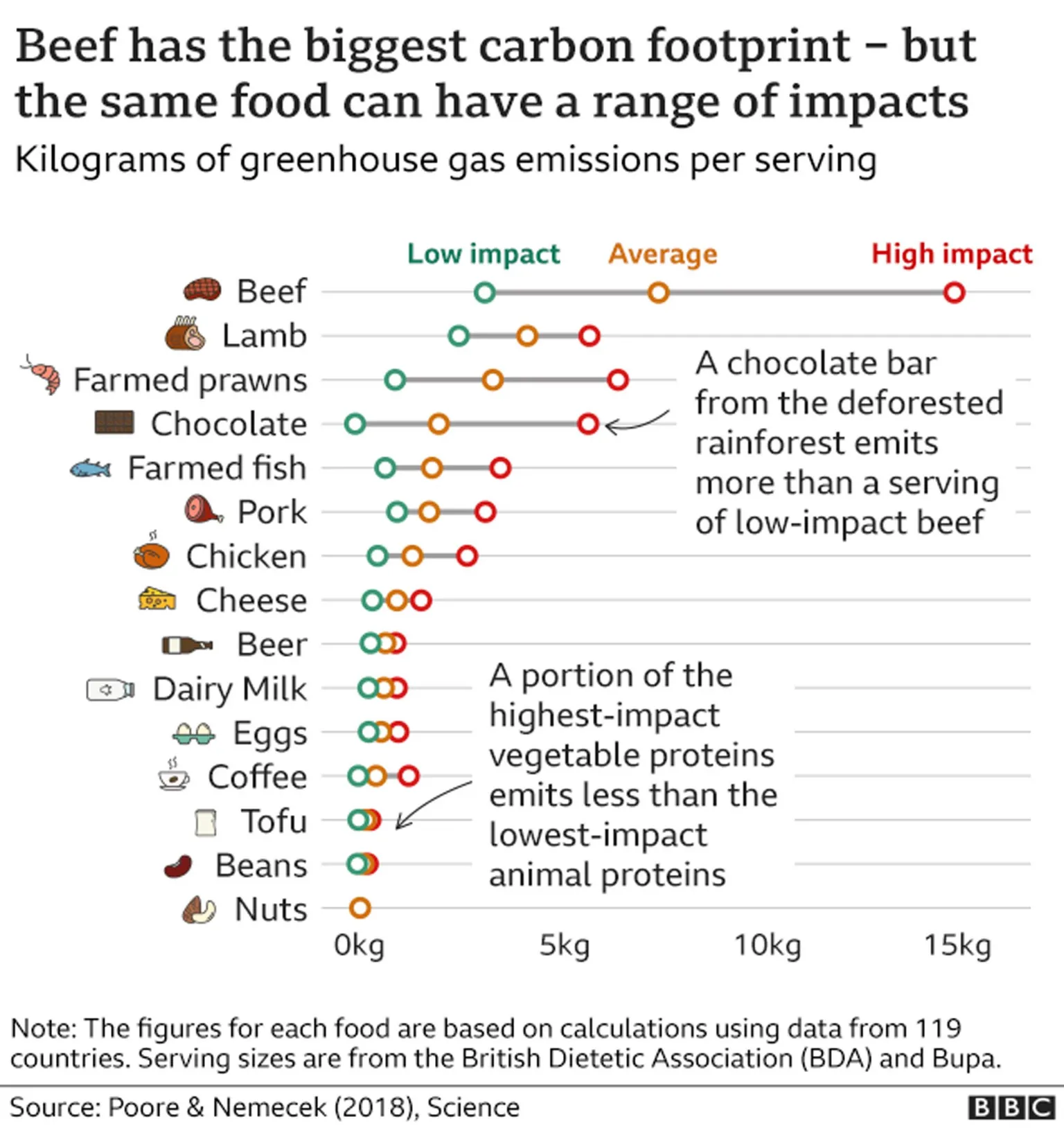
As you can see, the type of meat matters a lot. Cheese is doing worse than pork in this example (not sure I even believe this without more evidence yet). Non-meat sources of protein don‘t do very well: Tofu is just 2x better than poultry. Compare this to the giant bar for beef.
Better chart, apparently same source:
https://ichef.bbci.co.uk/news/1536/cpsprodpb/0477/production...
In short, yes, it would be theoretically possible to eliminate about 10% of global emissions if everyone everywhere stopped eating meat and replaced it with a balanced non-meat diet.
But such an outcome is not realistic.
This is my last comment on HN. It is sad what this corner of the internet has become.
I’m not sure this is possible, at least not in a typical yard or urban garden. According to one study[1] community gardens in and around cities emit six times the CO2 per serving compared to industrial agriculture. I assume this is roughly applicable to backyard gardens too. I wouldn’t be surprised if this isn’t applicable to livestock—which the study appears to have excluded—but also wouldn’t be surprised if the story is similar with chickens/livestock.
I imagine that even if it is less efficient to grow your chickens in the back yard, it might be possible to approach or exceed current industrial poultry farms in CO2 efficiency. My hunch is that if those farms get incentivized by penalties on CO2 production it would be impossible though.
[1] https://deepblue.lib.umich.edu/bitstream/handle/2027.42/1968...
- eat meat, and accept the impact to the environment, health risks, and mass unethical treatment of livestock
- stop eating meat, and accept that some of the foods you grew up eating, you can't eat any more
- mass unethical treatment (assuming you do not mean the fact that animals are killed) is related to the conditions which are related to price
- health risks can be minimal depending on the amount and type of meat you eat
- the CO2 impact again depends on the meat and conditions. Surely chicken in your backyard can be kept without CO2 impacts with some effort.
- your very existence has a CO2 impact. By your own logic you have two choices …
SBF said if he had a die and it had a 99% chance of killing everyone and a 1% chance of making the world 1 million times happier he would roll the die. Repeatedly. And Silicon Valley loved him.
I think AI is a similar calculation. Humans are tearing themselves apart and the only thing worth betting on is AI that can improve itself, self replicate and end scarcity. I believe that these VCs believe that AI is the only chance to save humanity.
And if you believe that, the net present value of AGI is basically infinite.
Scarcity, wow...
- There is no scarcity in the rich world by historical standards.
- There is extreme poverty in large parts of the world, no amount of human intelligence has fixed this and therefore no amount of AI will. It is primarily not a question of intelligence.
- On top of that "ending scarcity" is impossible due to the hedonistic treadmill and the way the human mind works as well as the fact that with or without AI there will still be disease, aging and death.
My general list of questions for those presenting a model of consciousness are: 1) Are you conscious? (hopefully you say yes or our friend Descartes would like a word with you!) 2) Am I conscious? How do you know? 3) Is a dog conscious? 4) Is a worm conscious? 5) Is a bacterium conscious? 6) Is a human embryo / baby consious? And if so, was there a point that it was not conscious, and what does it mean for that switch to occur?
I agree about the confusion of consciousness with intelligence, but these are complicated terms that aren't well suited to a forum where most people are interested in javscript type errors and RSUs. I usually use the term qualia. But to your example about existing for a few seconds without a train of thought; the Buddhists call this nirvana, and it's quite difficult to actually achieve.
> the Buddhists call this nirvana, and it's quite difficult to actually achieve.
Not really. The zen buddhists call what I described kensho and it's not very hard to achieve. I specifically said a few seconds. Probably anyone who wholeheartedly meditated for some time has experienced this.
Nirvana, on the other hand, is just the other side of practice-and-enlightenment as a drawn out process. You may call it hard to achieve, others may call it the dharma gate of ease and joy.
The typical “scale” mindset is almost the opposite of that — the people doing the scaling are the ones with agency, and the rest get served slop they didn’t choose!
If the system is an unreliable demo, then that can promote agency. In the same way that you could fix your car 40 years ago, but you can’t now, because of scaled corporate processes.
You can fix your car just fine - just not the electronics. And those were to a large degree added for safety reasons. It is due to the complexity that they are difficult or impossible to fix.
Yes.
Human intelligence consists of three things.
First, groundedness: The ability to form a representation of the world and one’s place in it.
Second, a temporal-spatial sense: A subjective and bounded idea of self in objective space and time.
Third: A general predictive function which is capable of broad abstraction.
At its most basic level, this third element enables man to acquire, process, store, represent, and continually re-acquire knowledge which is external to that man's subjective existence. This is calculation in the strictest sense.
And it is the third element -- the strength, speed, and breadth of the predictive function -- which is synonymous with the word "intelligence." Higher animals have all three elements, but they're pretty hazy -- especially the third. And, in humans, short time horizons are synonymous with intellectual dullness.
All of this is to say that if you have a "prediction machine" you're 90% of the way to a true "intelligence machine." It also, I think, suggests routes that might lead to more robust AI in the future. (Ground the AI, give it a limited physical presence in time and space, match its clocks to the outside world.)