I'll switch in Cloudflare Zero Trust for Okta simply for the fact that Cloudflare Access and Tunnels + An identity provider (we use M365) give you so much value (and it's free upto 50 users). It is even better if you are already running DNS on Cloudflare, you can securely deploy access-controlled apps on the internet without too much of a hassle and management. And with the recent addition for Infrastructure for SSH you can securely extend SSH access just as seamlessly.
 Readit News
arush15june commented on Infrastructure decisions I endorse or regret after 4 years at a startup (2024) cep.dev/posts/every-infra... · Posted by u/Meetvelde
arush15june commented on Take a look at Traefik, even if you don't use containers j6b72.de/article/why-you-... · Posted by u/q2loyp
I use caddy rather traefik. It's much easier to manage the Caddyfile compared to the traefik YAML config IMO, and we just keep three separate Caddyfiles for local, production and on-prem deployments. There are a plethora of great plugins, we use the coraza WAF plugin for caddy and it works well.
arush15june commented on Show HN: I built a tool to send 10k emails for $1 via AWS maillayer.com/... · Posted by u/mddanishyusuf
https://github.com/knadh/listmonk
We use listmonk, extremely flexible and lightweight as well! I want to try to build a Hubspot integration to fetch contacts directly from Hubspot.
arush15june commented on What Is Vsock and Why Use It with Unikernels? nanovms.com/dev/tutorials... · Posted by u/eyberg
First we run everything as processes on top of an OS kernel. On UNIX, we have all of these high-level concepts of letting processes interact with each other. Files, pipes, streaming/datagram UNIX sockets, etc.
Later on certain people started to see that these high-level concepts are bad. Operating systems are insecure. Context switching has overhead. Page table handling is expensive. So unikernels are invented.
People later discover that unikernels are somewhat hard to work with, as the only way they can talk to the outside world is through virtio-like devices:
- Unikernels aren't capable of just writing something to a simple file. No, they must write to a raw block device. Hey, that's annoying. Let's bring back support for native file access using virtio-fs! https://www.qemu.org/2020/11/04/osv-virtio-fs/
- Unikernels are also not capable of simply streaming data to another application. No, they must include their own Ethernet/IP/TCP stack, and on the host system you must set up a network bridge (hopefully with a firewall) just to let a couple of unikernels talk to each other. So let's solve that using AF_VSOCK!
At what point do unikernels become indistinguishable from ordinary processes running on top of an OS kernel in terms of features/behaviour, but reinvented poorly? I have the feeling that we're coming full circle at this point.
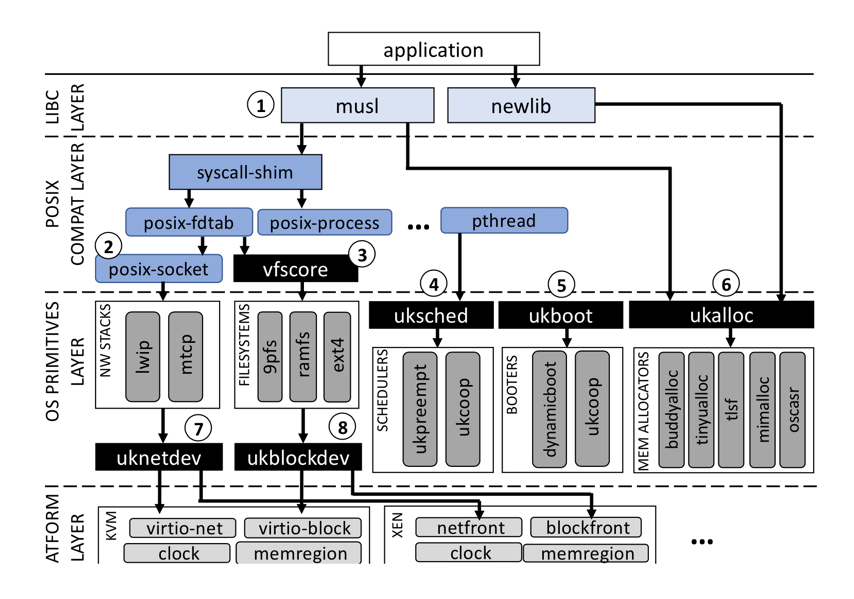
That's why I like the modular approach by Unikraft where the value is you can select which high level abstractions and libraries you want baked in the OS (including your application) [1].
Compared to other unikernels designs where the OS layer is minimal but mostly fixed.
[1] https://www.linux.com/wp-content/uploads/2021/02/unikraft1.p...
Nuitka is a pretty good compiler! I tried it this year for a small script that was used to automate generating Excel sheets with macros in them on Windows. It worked surprisingly well, but the ~100MB size was a turn off (and our Go binaries seem tiny compared to it). Though, we ended up writing a much faster and practical Powershell script for the same.
But python code as a statically compiled native executable is really cool, compared to other solutions like using pyInstaller.
If you think a 10MB binary is amazing, try out FLTK, your cross platform GUI programs can start at 100KB.
I wouldn't have minded even if it was 20MB.
The goal was having the convenience of building UI in React and have the heavy lifting done by Go. Both, stacks I am very familiar with and work with daily.
Wails is great! I've been working with wails v2 on Windows, and it's been a great experience. Built and delivered a Windows desktop application in Go + AntD for a customer really quickly.
It's a little complex app dealing with Win32 API's directly from Go and the binary being just 10MB is amazing, which can be compressed further with UPX.
Though, UPX-compressed Go binaries has a very high rate of being flagged by antivirus software (especially MS Defender).
arush15june commented on Ask HN: The book that did it for you in math and/or CS? · Posted by u/debanjan16
Operating Systems: Three Easy Pieces
https://pages.cs.wisc.edu/~remzi/OSTEP/
I failed the interview for an internship I really wanted in my 2nd year of engineering; I did get a shit internship that summer, but being really shaken at my incompetence, I took up this book, and quite honestly, it changed everything!
It truly sparked an interest in systems for me. The book helped me build a strong foundation in systems; Processes, memory, filesystems, networks, concurrency, synchronization and more. After reading OSTEP, it felt like an epiphany, and I charted a path for the rest of 2 years of college around distributed systems, systems research, and virtualization.
And the best part is that all this knowledge is free! Kudos to Professor Remzi and his work!